Is FatPirate Legit in the UK? Licence, Regulation and Trust Check
 Available in GB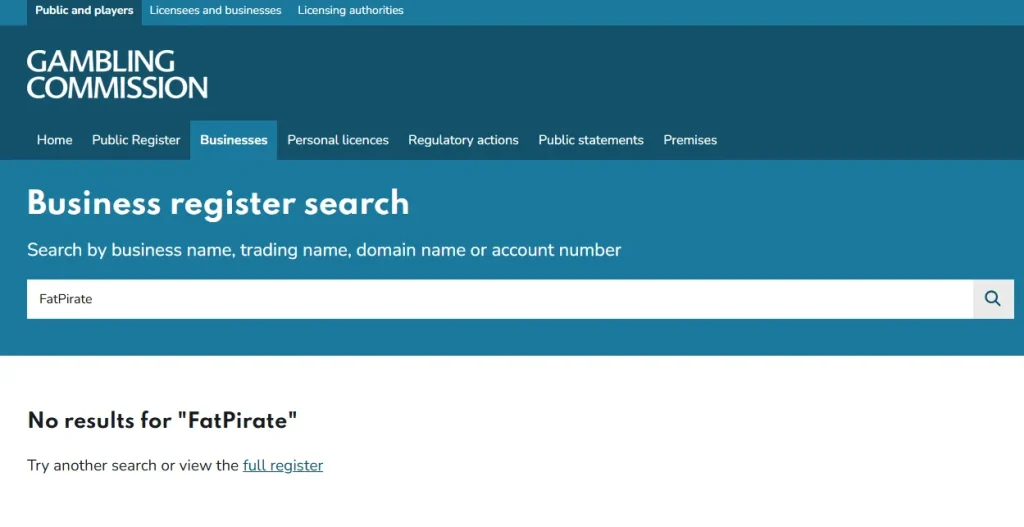
Start with the regulator register, not a marketing badge
The current UK Gambling Commission public business register does not show a verified FatPirate licence under the brand or domain. That matters because an operator offering remote casino facilities to consumers in Great Britain – England, Scotland and Wales – needs the appropriate Gambling Commission licence regardless of where the operator itself is based. Northern Ireland is different: general gambling there is governed under a separate devolved framework, although some UKGC licensing rules can still matter for remote operators with Great Britain equipment or advertising into Northern Ireland. The absence of a verified FatPirate UKGC licence does not by itself prove that every UK resident is blocked, but it does mean this guide does not attribute UKGC oversight, UKGC licence protections or Great Britain licensee obligations to FatPirate.
Table of Contents
- The licence result in one view
- What a UKGC register check proves – and what it does not
- Great Britain and the wider UK are not the same regulatory area
- What UKGC-licensed remote casinos must meet in Great Britain
- Why credit cards, GAMSTOP and slot limits are useful trust signals
- Bonus controls are another regulated-market comparison
- Financial checks in the licensed Great Britain market
- Access evidence is not licence evidence
- What the licence result means for KYC and withdrawals
- Where player complaints fit into the trust picture
- Practical trust checklist for a UK reader
- What UK players should weigh before trusting FatPirate
- Is FatPirate Legit in the UK? Licence, Regulation and Trust Check
The licence result in one view
The practical result is straightforward: the UK Gambling Commission public business register does not show a confirmed FatPirate licence under the brand or domain. The Commission’s register is designed to be searched by business name, trading name, domain name or account number.
For a reader in Great Britain, this is more important than a generic statement that a casino is “international” or “offshore”. The Gambling Commission says remote casino operators need its licence when they provide online casino facilities to consumers in Great Britain.
At the same time, a no-hit register result is not the same as evidence that FatPirate refuses all UK accounts. FatPirate’s own current Terms do not list the United Kingdom in the general excluded-jurisdictions section, although they do contain provider-specific restrictions that can affect UK users. Access, licensing and individual game availability are separate questions.
What a UKGC register check proves – and what it does not
A positive register match can establish that a named business holds a Gambling Commission operating licence and can expose its recorded licence status and associated trading or domain information. A negative brand or domain result means FatPirate’s local licensing cannot be verified from the regulator’s public record.
That negative result supports a narrow conclusion: FatPirate is not verified as UKGC-licensed or regulated by the Commission. UKGC Alternative Dispute Resolution arrangements, licence-condition protections and Commission oversight therefore cannot be attributed to a FatPirate account on the basis of the public register.
It also does not establish a substitute offshore licence. Secondary sources have attached different company names and jurisdictions to FatPirate, and those claims conflict. Until a current primary source resolves the operator and licence identity, no definitive offshore entity can be confirmed.
Great Britain and the wider UK are not the same regulatory area
The Gambling Commission’s core Gambling Act 2005 jurisdiction covers Great Britain: England, Scotland and Wales. The Commission states that it does not regulate general gambling activity in Northern Ireland in the same way because gambling there is devolved. Northern Ireland’s framework remains principally based on the Betting, Gaming, Lotteries and Amusements (Northern Ireland) Order 1985 as amended in 2022.
This distinction matters when using the phrase “UK casino licence”. A Great Britain remote operating licence is the relevant UKGC concept for consumers in England, Scotland and Wales. Northern Ireland cannot simply be folded into the same sentence as if the Commission had identical regulatory powers throughout the whole United Kingdom.
The Commission also notes that certain remote operators with key equipment in Great Britain, or operators advertising remote gambling into Northern Ireland, may still need a Gambling Commission licence. That is a specific legal route and does not convert Northern Ireland into the same general regulatory territory as Great Britain.
What UKGC-licensed remote casinos must meet in Great Britain
A useful way to understand the licence gap is to compare FatPirate with requirements that apply to Gambling Commission licensees. These are market benchmarks, not confirmed FatPirate features.
| Great Britain licence requirement or rule | Current UKGC position | Can it be assumed for FatPirate? |
|---|---|---|
| Remote casino operating licence | Required to provide online casino facilities to consumers in Great Britain | No – no FatPirate UKGC licence was verified |
| Credit-card gambling | Online casino licensees must not accept credit-card gambling payments, including through e-wallet routes funded by credit cards | No – the rule does not establish FatPirate payment compliance |
| National self-exclusion | Remote licensees within scope must participate in the national multi-operator scheme | No – no definitive GAMSTOP coverage is claimed for FatPirate |
| Online slot stake caps | £5 per game cycle for age 25+ and £2 for ages 18-24 | No – these are conditions on remote casino operating licences |
| Bonus wagering cap | Licensees may not impose wagering requirements above 10x bonus funds | No – this is a UKGC licence rule, not a verified FatPirate term |
| Financial-limit prompt | Licensed businesses must prompt customers to set a financial limit before first deposit | No – the feature is not confirmed for FatPirate |
The comparison separates regulated-market expectations from FatPirate-specific features. A requirement that applies to UKGC licensees does not establish that FatPirate implements the same feature unless it is directly documented for the brand.
Why credit cards, GAMSTOP and slot limits are useful trust signals
The Gambling Commission’s credit-card ban is explicit: licensed online betting, casino and bingo operators must not accept credit-card gambling payments, and operators need to prevent e-wallet use where the wallet was loaded from a credit card. The rule is part of the Great Britain licensed environment.
Similarly, the Commission’s remote multi-operator social-responsibility code requires relevant remote licensees to participate in the national self-exclusion scheme. That creates a clear regulatory baseline for GAMSTOP participation among operators that fall within the provision.
Online slots have another visible benchmark. Since 2025, remote casino operating licences carry maximum per-cycle stakes of £5 for customers aged 25 or over and £2 for 18 to 24 year olds. The Commission also retains a minimum 2.5-second interval between the start of one slots game cycle and the next.
These rules help a UK reader understand what licensed-market protections look like, but they do not establish equivalent FatPirate protections without a relevant licence or direct feature confirmation.
Bonus controls are another regulated-market comparison
The current Gambling Commission social-responsibility code says licensees must not apply wagering requirements above 10 times bonus funds, and incentives must not combine more than one gambling product. These rules are now a useful benchmark when looking at any casino bonus presented to a Great Britain audience.
FatPirate has its own promotion terms, and its public promotions material can change. The bonus terms therefore evaluates FatPirate’s offer wording on its own evidence rather than assuming that the UKGC 10x cap applies to the brand.
This distinction is especially important when marketing language looks familiar. A bonus can resemble offers from a UKGC licensee without proving that the operator behind it is part of the Great Britain licensing system.
Financial checks in the licensed Great Britain market
The Great Britain framework has also moved toward more structured financial safeguards. The Commission says licensed businesses must prompt customers to set a financial limit before their first deposit. Separate light-touch financial vulnerability checks use public data and currently apply at the £150 net-deposit threshold over a rolling 30-day period.
Financial Risk Assessments are a different measure. In July 2026 the Commission announced a staged implementation, with the timetable for stage one still to be confirmed. The first stage is designed for very high spending, initially above £5,000 net deposits in 24 hours for customers aged 25 and over and £2,500 for under-25s, with lower thresholds planned for later stages.
These are requirements and implementation plans for the regulated Great Britain market, not confirmed FatPirate account controls. No UKGC licence has been verified for the brand.
Access evidence is not licence evidence
FatPirate’s current Terms do not name the United Kingdom in the general list of excluded jurisdictions. That is evidence about the wording of the operator’s own access rules, not evidence of a Gambling Commission licence. The same Terms separately state that some providers impose their own territorial restrictions, including a UK restriction for NetEnt content.
These two facts can coexist with the regulator result. A site can have UK-facing access signals or accept account attempts without appearing as a UKGC-licensed operator. Conversely, a provider restriction can remove a slice of the game library without proving that the whole account is unavailable.
The FatPirate review keeps those availability questions separate from licensing. That separation avoids both extremes: it neither converts a no-register-hit into a blanket account ban nor treats visible access as proof of local regulation.
What the licence result means for KYC and withdrawals
FatPirate has its own account-verification and withdrawal terms, including KYC checks and payment processing rules. Those terms can be read and assessed as operator rules, but they should not be presented as UKGC-approved processes when no licence has been verified.
The KYC and account checks covers the current document examples and verification timing from FatPirate’s Terms. The withdrawal evidence covers the operator’s published processing stage and separates that from recent consumer experience.
That is the more useful trust test than attaching a vague “safe” or “unsafe” label. Check what the operator promises, what the regulator register verifies, and what recent payment evidence shows – then keep those evidence types distinct.
Where player complaints fit into the trust picture
A licence check answers who regulates the operator locally; player reviews answer a different question about reported experience. Complaint patterns can reveal recurring friction, but they are not a substitute for regulator evidence and does not establish a licensing conclusion.
For that reason, detailed recent complaint evidence belongs on the player reviews. This page keeps the focus on regulatory status, Great Britain rules and the limits of what can be inferred from a register result.
If you are deciding whether to deposit, use both layers: the regulator check for formal protection and the reputation evidence for how users say payments and support are working in practice.
Practical trust checklist for a UK reader
- Check the UKGC register yourself. Search the brand, domain and any clearly disclosed operator name before assuming Great Britain licensing.
- Do not substitute an offshore badge for a UKGC licence. Offshore operator claims about FatPirate are currently inconsistent, so a specific jurisdiction should not be stated without primary evidence.
- Keep Great Britain and Northern Ireland separate. The Commission’s general Gambling Act 2005 remit covers England, Scotland and Wales, not Northern Ireland in the same way.
- Treat UKGC rules as benchmarks unless a licence is verified. Credit-card restrictions, GAMSTOP participation, slot stake caps and bonus rules are not automatically FatPirate features.
- Separate access from regulation. A site not naming the UK in its general exclusion list does not prove local licensing.
- Read payment evidence before depositing. Licence status is only one part of the decision; withdrawal terms and recent user experience are separate inputs.
What UK players should weigh before trusting FatPirate
The strongest verified regulatory fact is the missing local match: the UK Gambling Commission public business register does not show a verified FatPirate licence under the brand or domain. For consumers in Great Britain, that matters because remote casino operators serving them need the appropriate Commission licence, and the normal package of Great Britain licensee requirements should not be assumed without it.
That result should be interpreted precisely rather than dramatically. It does not by itself prove that every UK account is blocked, and it does not establish which offshore entity or jurisdiction, if any, currently sits behind the brand. Those claims remain unresolved where sources conflict.
A careful UK decision therefore combines three separate checks: the regulator register, FatPirate’s own account and payment terms, and current player experience. If local licence protections are important to you, the absence of a verified UKGC licence is a material factor rather than a minor footnote.